
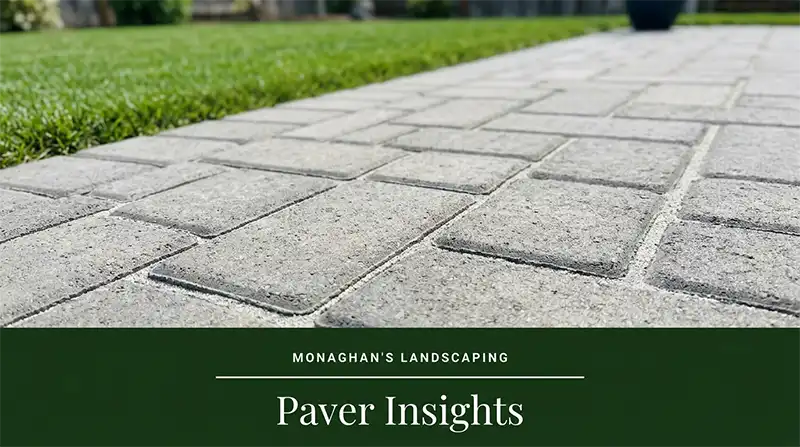
The pavers are what you see. The base, grading, and drainage underneath are what determine whether the surface stays flat, drains properly, and lasts. On Portland’s clay soil, getting the subsurface right is the difference between a patio that performs for decades and one that settles, heaves, and pools water within a few years.
Here’s what goes under the pavers, why each layer matters, and how Portland’s soil and climate affect every decision.
NOTE: For full details on how we approach paver installation projects, see our dedicated service page.
Why Portland’s Clay Soil Creates Problems for Pavers
Clay does two things that work against paver installations. First, it holds water. When it rains, clay soil absorbs moisture and expands. When it dries out in summer, it contracts. This seasonal expansion and contraction cycle moves the ground surface up and down by fractions of an inch, which is enough to shift pavers, open joints, and create uneven surfaces over time.
Second, clay doesn’t drain. Water that reaches the clay layer sits there until it evaporates or is absorbed very slowly. If the paver base sits directly on clay without adequate depth and drainage provisions, water pools beneath the surface, softens the base, and causes the pavers above to settle unevenly.
The solution to both problems is the same: excavate deep enough to replace the clay with stable, free-draining aggregate, and grade the finished surface so water moves away from structures instead of sitting on or under the pavers.
What Goes Under the Pavers
Excavation Depth
On Portland’s clay soil, we excavate 8 to 12 inches below the finished paver surface for patios and walkways, and deeper for driveways that support vehicle loads. This depth removes the unstable topsoil and clay and creates room for the aggregate base that replaces it. Skimping on depth is the most common shortcut on substandard paver installations, and it’s the one that shows up first as settlement and unevenness.
Geotextile Fabric
A layer of geotextile fabric goes down on the excavated clay surface before any aggregate is placed. The fabric separates the base material from the clay underneath, preventing the clay from migrating up into the aggregate and compromising its drainage and structural properties. Without it, clay particles work their way into the gravel over time and the base gradually loses its ability to drain and support loads evenly.
Aggregate Base
Crushed aggregate (typically 3/4-inch minus) is placed on top of the fabric and compacted in lifts (layers) using a plate compactor. Each lift is compacted before the next one is added. This creates a dense, stable foundation that distributes loads evenly and doesn’t shift when the clay underneath expands or contracts. The total compacted base depth varies by application: 6 to 8 inches for patios, 10 to 12 inches for driveways.
Bedding Sand
A 1-inch layer of coarse bedding sand is screeded (leveled) on top of the compacted aggregate. This is the setting surface for the pavers. The sand fills minor irregularities in the base and allows each paver to bed into a uniform plane. Bedding sand must be screeded precisely because any variation here translates directly into an uneven finished surface.
Edge Restraint
Aluminum or plastic edge restraints are anchored with spikes around the full perimeter of the paver field. These prevent the outer pavers from creeping outward over time as the surface is loaded and unloaded through use. Without edge restraint, the entire field gradually migrates outward, opening joints and allowing the surface to lose its interlock.
How Grading Affects Paver Performance
Grading is the slope of the finished surface. Every paver surface needs to slope away from the house and toward a drainage point at a minimum of 1% (about 1/8 inch per foot). This slope is set during base preparation, not after the pavers are laid. By the time pavers go down, the grade is already determined by the shape of the compacted aggregate underneath.
Grading away from the house. Any patio attached to the house must slope away from the foundation. Water that flows toward the house pools against the foundation wall, enters crawl spaces, and contributes to the same moisture problems that drainage systems are designed to prevent. Even a correctly installed patio that slopes the wrong direction creates a new drainage problem while solving an aesthetic one.
Grading toward a drainage point. The water running off the paver surface needs somewhere to go. On a properly graded patio, water flows toward a lawn area that can absorb it, a catch basin, a landscape bed, or a drainage swale. If the surrounding grade directs that water back toward the patio or the house, the grading has failed regardless of how well the pavers were laid.
Cross-slope for larger surfaces. Patios wider than 15 feet may need cross-slope (a slight grade from one side to the other) in addition to the grade away from the house, to prevent water from pooling in the center of the surface. This is especially important on Portland properties where a large patio receives both direct rainfall and runoff from an adjacent roof line.
When Pavers Need Additional Drainage
Grading handles surface water, but some patio locations need more than surface slope to stay dry:
Patios at the base of a slope. If the patio sits at the bottom of a yard that slopes toward it, surface runoff and subsurface water from uphill will flow toward the patio during every rain event. A catch basin or channel drain at the uphill edge of the patio, or a French drain intercepting the subsurface water before it reaches the patio base, prevents the patio from becoming a collection point.
Patios adjacent to downspouts. Roof downspouts can dump hundreds of gallons per hour onto the area next to a patio. If the downspout discharges near the patio edge, that concentrated runoff erodes the base and undermines the edge restraint over time. Routing downspouts into underground pipe that discharges away from the patio is a standard part of our paver installations when downspouts are in the area.
Low-lying properties. On flat lots in Beaverton, Clackamas, and Milwaukie where the yard has minimal natural slope, surface water may not have a clear exit path. A catch basin at the low edge of the patio connected to pipe routing water to the street or a dry well keeps the patio area from becoming the default water collection point on the property.
Retaining wall adjacency. Patios built above or below a retaining wall need drainage coordination between the patio surface, the wall’s drainage system, and the surrounding grade. Water from the patio shouldn’t drain into the soil behind the wall (adding hydrostatic pressure), and water from behind the wall shouldn’t discharge onto the patio surface.
What Happens When the Base Is Done Wrong
Every paver problem a homeowner notices on the surface started underneath:
Uneven surface or rocking pavers. The base wasn’t compacted uniformly or the bedding sand wasn’t screeded level. Individual pavers sit at slightly different heights and rock when stepped on.
Settlement in one area. The base was too shallow in that section, or the clay underneath wasn’t fully excavated. The remaining clay compressed under load and the pavers above sank with it.
Water pooling on the surface. The grade wasn’t set correctly during base preparation, or the surface has settled in a low area since installation. The fix is usually a partial lift-and-reset (pulling up the pavers in the affected area, adding aggregate, recompacting, and relaying) rather than a full rebuild.
Weeds growing through joints. Joint sand has washed out or decomposed, leaving gaps where seeds germinate. This is a maintenance issue (polymeric sand needs to be intact to block growth), but it’s accelerated when the base allows water to push upward through the joints during heavy rain.
Edge creep. The perimeter pavers have shifted outward, opening joints along the edges. Either the edge restraint was inadequate, missing, or the base along the perimeter wasn’t compacted as thoroughly as the interior.
How We Handle It
Every paver project we install starts with excavation to full depth, geotextile fabric on the clay, aggregate compacted in lifts, precision-screeded bedding sand, and anchored edge restraints. Grading is verified with a level at every stage. If the site needs additional drainage (catch basins, French drains, downspout routing), we install that during the base work, not as an afterthought.
The result is a surface that stays flat, drains correctly, and doesn’t settle on Portland’s clay soil. The pavers get the credit for how it looks. The base is why it lasts.
Call (503) 847-9110 or request your free estimate online.
Learn More About Pavers
5 Paver Patio Design Ideas for Portland Backyards — Patterns, materials, and layouts that work in the Pacific Northwest.
Permeable Pavers in Portland — How they work, when they make sense, and when standard pavers with drainage are the better choice.
Backyard Drainage and Grading Guide — How to evaluate your yard and understand your drainage options.
How Much Does a Paver Patio Cost in Portland? — 2026 pricing by project size, materials, and what drives cost.
Pavers vs. Concrete: Which Is Better for Portland? — A side-by-side comparison of durability, cost, drainage, and maintenance.
How Long Do Pavers Last in Portland? — Maintenance schedule, common issues, and what to expect over 25+ years.