The material you choose for a retaining wall affects how long it lasts, how much it costs, how it handles Portland’s rain and clay soil, and what it looks like on your property. There’s no single best material for every situation. The right choice depends on wall height, soil conditions, drainage requirements, the look you want, and your budget.
Here’s how the four most common retaining wall materials compare on Portland properties.
Concrete Block (Segmental Retaining Wall Systems)
Concrete block is the most commonly installed retaining wall material in the Portland metro area. Systems like Allan Block, Belgard, and Pavestone use interlocking units that stack without mortar and lock together with lips, pins, or gravity. They’re engineered for structural performance and come in a range of textures and colors.
Why it works in Portland: Concrete block handles Portland’s wet conditions well because the units themselves don’t absorb significant moisture. The interlocking design allows the wall to flex slightly with seasonal soil movement without cracking, which matters on clay that expands when wet and contracts when dry. Block walls integrate easily with gravel backfill and perforated drain pipe, which every retaining wall in Portland needs behind it.
Best for: Structural walls over 2 feet, hillside stabilization, terraced yard systems, walls that need to support surcharge loads (driveways, patios above). Walls over 4 feet can be engineered with geogrid reinforcement.
For details on how we build these walls in Portland, see our retaining wall installation page.
Limitations: The manufactured look doesn’t suit every aesthetic. Color options have improved significantly, but concrete block still reads as “engineered” rather than natural. On very tight-access properties in older Portland neighborhoods like Sellwood or Laurelhurst, getting pallets of block to the build site can add to labor cost.
Cost range: $25 to $45 per square face foot installed, depending on block style, wall height, and site conditions.
Lifespan: 50+ years with proper drainage and installation.
Natural Stone
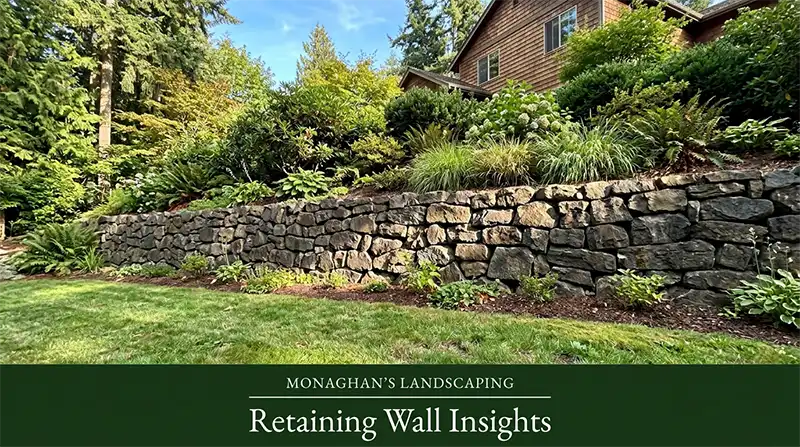
Natural stone walls use quarried basalt, granite, or sandstone stacked either dry (no mortar) or wet-set (with mortar). In Portland, basalt is the most locally available stone because of the region’s volcanic geology. Natural stone walls look distinctive and blend with the Pacific Northwest landscape.
Why it works in Portland: Basalt is extremely dense and handles moisture without deterioration. Dry-stacked stone walls allow water to pass through the joints, which provides built-in drainage relief that other materials need to achieve with pipe and gravel alone. The natural look suits properties in West Linn, Lake Oswego, and the West Hills where the landscape already has a wooded, organic character.
Best for: Decorative and low-to-medium height walls (1 to 4 feet), garden walls, terracing in visible areas where appearance matters. Mortared stone can go taller with engineering.
Limitations: More expensive than concrete block because the material is heavier, harder to handle, and takes longer to install. Dry-stacked walls over 3 feet require a skilled mason who understands how to batter (lean back) the wall and interlock irregular stones for stability. Not every landscaping crew has this skill set.
Cost range: $35 to $65 per square face foot installed. Basalt is on the lower end of natural stone pricing in Portland because it’s locally sourced. Granite and imported stone cost more.
Lifespan: 75+ years for dry-stacked basalt. Essentially permanent if the base doesn’t shift.
Boulders
Boulder walls use large, naturally shaped rocks (typically 1 to 4 feet in diameter) placed with an excavator to form a terraced or stacked wall. They’re common on properties in the Portland metro where a natural, informal look is preferred and the site has room for the footprint a boulder wall requires.
Why it works in Portland: Boulders are heavy enough to resist hydrostatic pressure from saturated clay soil without additional reinforcement on shorter walls. Water drains through the gaps between boulders, providing passive drainage. The material is durable in Portland’s freeze-thaw cycles (20 to 30 per winter) because there are no mortar joints to crack.
Best for: Informal terracing on larger properties, slope stabilization where a natural look is the goal, walls along creek banks or wooded lots. Common on properties in Happy Valley, Damascus, and rural Clackamas County where lot sizes accommodate the footprint.
Limitations: Boulder walls take up more horizontal space than block or stone walls because the boulders are set at an angle. A 4-foot boulder wall might need 4 to 6 feet of horizontal depth. On smaller urban lots, this eats into usable yard space. Boulders also can’t be cut or shaped precisely, so the finished wall has an irregular profile. For applications where a clean, straight line matters (along a driveway, next to a patio), block or cut stone is a better fit.
Cost range: $20 to $40 per square face foot installed. Material cost is relatively low, but delivery and equipment (excavator) add to the total. Access-restricted sites increase cost significantly.
Lifespan: Indefinite. Boulders don’t degrade. The only failure mode is base erosion or undermining, which proper installation prevents.
Timber
Timber retaining walls use pressure-treated landscape timbers (typically 6×6 or 6×8) stacked horizontally and anchored with rebar or deadman anchors. They were the standard residential retaining wall material in Portland for decades and are still found on many older properties.
Why it’s common in Portland: Timber is the least expensive retaining wall material and the fastest to install. For short walls under 2 feet, it’s a practical choice that gets the job done at the lowest cost. The material is widely available from Portland-area lumber suppliers.
Limitations: Timber is the shortest-lived retaining wall material, especially in Portland’s wet climate. Even pressure-treated wood deteriorates when buried in saturated clay soil year after year. Typical lifespan in Portland is 10 to 15 years before the lower timbers rot and the wall begins to lean or fail. Timber walls are also limited in height (3 to 4 feet maximum for structural stability) and don’t integrate with geogrid reinforcement for taller applications. We see many timber wall replacement projects where the original wall lasted 12 to 15 years and the homeowner replaces it with concrete block or stone for permanent performance.
Best for: Short garden walls, raised beds, temporary slope management, situations where budget is the primary constraint and a 10-to-15 year lifespan is acceptable.
Cost range: $15 to $30 per square face foot installed.
Lifespan: 10 to 15 years in Portland conditions. Shorter if drainage behind the wall is inadequate.
How Portland’s Conditions Affect Material Choice
Three local factors weigh heavily on material selection here:
Clay soil. Portland’s clay expands when wet and contracts when dry, putting lateral pressure on walls that varies by season. Materials that flex (concrete block with interlocking joints, dry-stacked stone, boulders) handle this better than rigid materials (poured concrete, mortared stone). Every material choice also needs proper drainage behind the wall to prevent hydrostatic pressure from building against the back face. For more on how drainage integrates with retaining walls, see our drainage solutions page.
Rainfall. Portland gets 43+ inches of rain annually, most of it between October and May. Any wall material that absorbs moisture (timber, some porous stone) degrades faster here than in drier climates. Materials that shed water or don’t absorb it (concrete block, dense basalt, boulders) perform best long-term.
Freeze-thaw cycles. Portland averages 20 to 30 freeze-thaw cycles per winter. Water trapped in porous materials or mortar joints expands when it freezes, causing spalling and cracking over time. Dense materials and dry-stacked construction methods resist this better than mortared assemblies.
Which Material Should You Choose?
Here’s the short version:
Structural wall over 3 feet, needs to last 50+ years: Concrete block. It’s the workhorse material for a reason.
Visible wall where appearance matters most: Natural stone (basalt for a Pacific Northwest look) or boulders (for a naturalistic setting).
Large property, informal terracing, natural look: Boulders. Low cost per face foot and essentially permanent.
Short garden wall, tight budget: Timber. Accept the 10-to-15 year lifespan and budget for eventual replacement.
The best way to narrow it down is to have someone look at the specific slope, soil, drainage, and access conditions on your property. Material choice is a site-specific decision, not a preference decision. We assess all of this during the free on-site consultation.
Call (503) 847-9110 or request your free estimate online.
Learn More About Retaining Walls
Retaining Wall Installation Cost in Portland — Full pricing breakdown by wall size, materials, and site conditions.
Most Affordable Retaining Wall Materials in Portland — Options for budget-conscious projects.
Do Retaining Walls Require Permits in Portland? — What triggers a permit and who handles it.
How Drainage Works with Retaining Walls — Why every retaining wall in Portland needs drainage behind it.