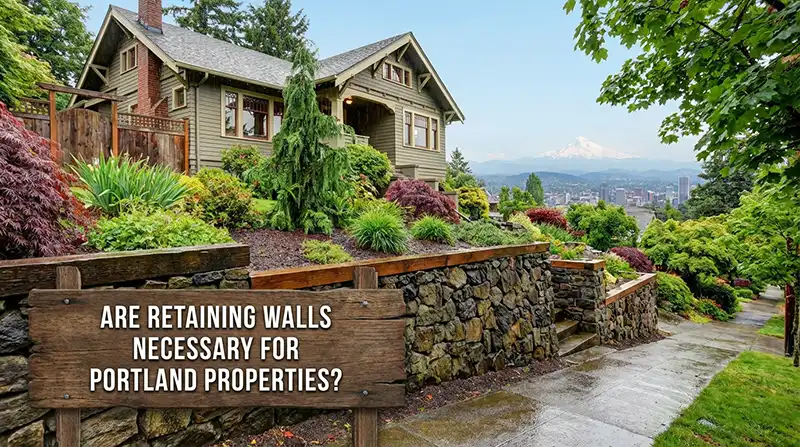
Not every sloped yard in Portland needs a retaining wall. Some slopes are stable, well-drained, and functional without any structural intervention. But many Portland properties do need one, and the signs that you’re in that category are usually visible if you know what to look for.
Here’s how to evaluate whether your property needs a retaining wall, what problems a wall actually solves, and what happens if you wait too long on a slope that needs one.
Signs Your Property Needs a Retaining Wall
NOTE: For details on materials, process, and pricing, visit our retaining wall installation page.
Soil Is Moving Downhill
If you see mulch migrating out of beds after every rain, bare patches of exposed dirt where ground cover used to be, or a gradual buildup of soil at the bottom of a slope, the ground is eroding. On Portland’s clay soil, erosion accelerates once it starts because the surface layer that holds everything in place gets thinner each season. A retaining wall stops the movement by physically holding the soil in place at the grade change.
The Yard Is Too Steep to Use
A slope that drops 3 feet or more over a short distance makes that section of the yard unusable for anything practical. You can’t set up chairs, kids can’t play on it, and mowing it is a safety hazard when the grass is wet (which in Portland means most of the year from October through May). A retaining wall creates a level terrace above or below the wall, converting dead slope into usable space.
Water Pools at the Base of the Slope
Water running downhill and collecting at the bottom of a slope is a grading and drainage problem. If the pooling happens against the house, a patio, or a walkway, it’s also a damage problem. A retaining wall combined with proper drainage behind and around it can redirect both the soil and the water, solving both issues with one structure.
A Fence or Structure Is Leaning
If a fence line, shed foundation, or driveway edge along a slope is shifting, leaning, or cracking, the soil underneath is moving. This is slope creep, and it’s the slow-motion version of erosion. Gravity pulls saturated clay downhill continuously, a few millimeters at a time, until something visible breaks. A retaining wall at the grade change arrests the movement and protects whatever is downhill from it.
Your Neighbor’s Property Is Higher (or Lower)
Grade differences between adjacent properties are one of the most common retaining wall triggers in Portland’s hillside neighborhoods. If your neighbor’s yard sits 2 to 4 feet above yours and there’s no wall, their soil and runoff drain directly onto your property. Conversely, if your yard is the higher one, you may be responsible for retaining your own soil to prevent it from encroaching on their property. We see this frequently in West Linn, Lake Oswego, and Happy Valley where lots were graded at different elevations during development.
When You Probably Don’t Need a Retaining Wall
Not every slope is a problem. Here are situations where a wall might not be necessary:
Gentle slopes under 2 feet of grade change. A slope that drops 18 to 24 inches over a 10 to 15 foot run can often be managed with regrading, ground cover plantings, or a drainage correction rather than a wall. The soil isn’t under enough gravitational stress to require structural retention.
Stable, well-vegetated slopes. If the slope has established root systems (trees, shrubs, deep-rooted ground covers) and shows no signs of erosion after years of Portland rain, it’s holding itself. Vegetation is nature’s retaining system. Removing that vegetation for a construction project, however, often destabilizes the slope and creates the need for a wall that didn’t exist before.
Slopes away from structures. A slope at the far back of the property that doesn’t affect the house, driveway, or any usable space may not justify the investment. If the erosion isn’t threatening anything and the slope isn’t needed for functional use, monitoring it may be the right call.
What Happens If You Wait
Slopes that need retaining walls don’t improve on their own. They get worse. Here’s the typical progression on a Portland property:
Year 1-2: Minor erosion. Mulch washes out of beds, a thin layer of topsoil moves downhill after heavy storms. Easy to ignore.
Year 3-5: Erosion channels form. Bare soil becomes visible. Ground cover thins. Water starts pooling at the base of the slope in places it didn’t before. The grade change becomes more pronounced as soil migrates.
Year 5-10: Structural signs appear. Fence posts along the slope lean. A patio edge at the bottom of the slope heaves or settles unevenly. Foundation moisture increases if the slope faces the house. The cost to fix the problem now is higher than it would have been in year 1 because the erosion has undermined surfaces, plantings, and structures that need to be repaired or replaced in addition to building the wall.
The retaining wall itself doesn’t get more expensive over time (material and labor costs aside). But the total project cost increases because of the collateral damage that accumulates while you wait.
Portland Neighborhoods Where Retaining Walls Are Most Common
Retaining walls are installed across the entire Portland metro area, but some areas have more of them because of terrain:
West Linn: Steep lots with significant grade changes between the street and the backyard. Many properties sit on slopes overlooking the Willamette or Tualatin Rivers.
Lake Oswego: Mature neighborhoods like Palisades and First Addition where hillside lots were developed on natural slopes. Older homes often have failing timber walls that need replacement.
Happy Valley and Sunnyside: Newer development on rolling terrain where cut-and-fill grading during construction created abrupt grade changes between lots.
West Hills and Portland Heights: Some of the steepest residential terrain in the metro area. Retaining walls here often serve double duty as slope stabilization and usable space creation.
Damascus and Clackamas County: Larger lots with natural grade changes and properties along creek corridors where erosion control is a priority.
What a Retaining Wall Actually Costs
Residential retaining wall projects in Portland typically range from $3,500 for a small garden wall to $25,000+ for a large structural wall with engineering, drainage, and grading. The variables are wall height, length, material, site access, and drainage complexity. For a detailed pricing breakdown, see our retaining wall cost guide.
The cost of not building a wall when one is needed is harder to quantify, but it shows up in foundation repairs ($5,000 to $30,000+), patio and hardscape replacement, landscape restoration, and in some cases, liability if your soil encroaches on a neighbor’s property.
How to Find Out If You Need One
The fastest way to know is to have someone look at the slope. We provide free on-site assessments throughout the Portland metro area. We’ll evaluate the grade, soil, drainage, and any signs of movement, and tell you whether a retaining wall is the right solution or if a simpler fix (regrading, drainage, plantings) will handle it.
Call (503) 847-9110 or request your free estimate online.
Learn More About Retaining Walls
Retaining Wall Installation Cost in Portland — Full pricing breakdown by wall size, materials, and site conditions.
Best Retaining Wall Materials for Portland Homes — Comparing concrete block, natural stone, boulders, and timber.
Do Retaining Walls Require Permits in Portland? — What triggers a permit and who handles it.
How Drainage Works with Retaining Walls — Why every retaining wall in Portland needs drainage behind it.
Retaining Wall Planning Guide — How to evaluate your yard and plan a retaining wall project.