
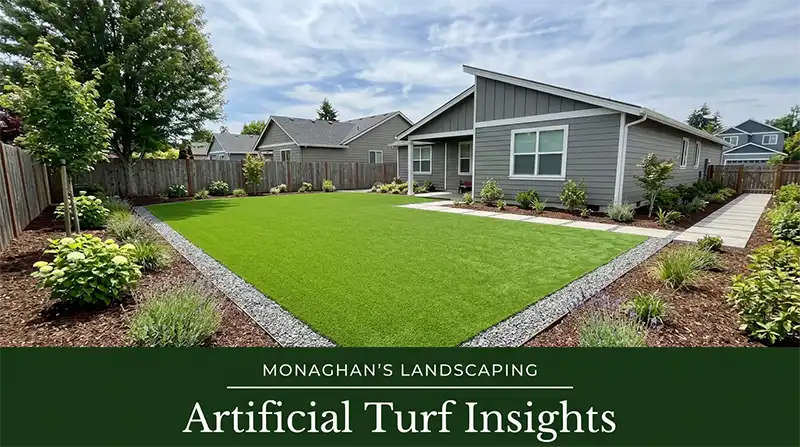
The short answer: you can install artificial turf over concrete with proper preparation. You cannot install it over an existing lawn. The grass, roots, and organic material underneath will decompose, create odor, attract pests, and prevent the turf from draining. Here’s what each scenario requires and why the base preparation matters as much as the turf itself. Our turf installation service page walks through the full process.
Installing Turf Over an Existing Lawn: Why It Doesn’t Work
This is the most common question we get, and the answer is always the same: the old lawn has to come out first. Here’s what happens if you don’t:
The grass decomposes underneath. Living grass under a sheet of turf dies immediately because it’s cut off from sunlight. As it decomposes, it creates a layer of wet, rotting organic material that smells, attracts insects, and generates heat. In Portland’s wet climate, this decomposition happens faster than in dry regions because the moisture accelerates the process.
The surface becomes uneven. Decomposing grass and root systems settle unevenly, creating bumps and depressions in the turf surface above. A lawn that looks flat when the turf is installed develops visible undulations within a few months as the organic material underneath compresses at different rates.
Drainage fails. The organic layer traps water between the turf backing and the soil. In Portland, where it rains 43+ inches per year, that trapped water has nowhere to go. The turf becomes spongy, puddles form, and the base stays saturated for months during the rainy season.
Weeds grow through. Without a proper weed barrier between clean base material and the turf, surviving root systems and weed seeds push through the turf backing. Artificial turf installed over an existing lawn almost always develops weed problems within the first year.
What Proper Lawn Removal Looks Like
We strip the existing lawn with a sod cutter to remove the grass, roots, and top layer of organic soil. Then we excavate an additional 3 to 4 inches of subsoil to reach stable mineral soil. The total excavation is typically 4 to 6 inches below the original grade.
After excavation, we install a weed barrier fabric, then build up the base with crushed aggregate (typically 3/4-inch minus) compacted in lifts to create a stable, well-draining foundation. A layer of decomposed granite or fine crushed rock goes on top as the bedding layer that the turf sits on.
On Portland’s clay soil, the aggregate base serves double duty: it provides structural support for the turf and creates a drainage layer that the clay underneath can’t provide on its own. Without this base, water that passes through the turf backing hits clay and sits there. With it, water moves through the aggregate and disperses laterally to drainage outlets or percolates slowly into the subsoil.
Installing Turf Over Concrete: When and How It Works
Concrete is a stable, hard surface that doesn’t decompose, settle unevenly, or grow weeds. That makes it a viable substrate for turf in some situations. But it’s not as simple as rolling turf out over the slab.
When It Works
Concrete patios you want to convert to a green space. A cracked, stained, or unused concrete patio in the backyard can be transformed into a turf area without the cost of concrete demolition and disposal. This is common on Portland properties where the previous homeowner poured a large concrete slab that the current owner doesn’t use.
Covered areas. Concrete under a covered porch, carport, or patio cover is already protected from direct rain. Turf over concrete in covered areas works well because drainage demand is minimal.
Rooftop or balcony installations. Concrete or composite decking on rooftops and balconies can be surfaced with turf for a green look. The turf sits on a foam or rubber pad rather than directly on the concrete.
What Needs to Happen
Drainage. Concrete is impervious. Water that passes through the turf backing pools on the concrete surface unless there’s a way for it to exit. The concrete must slope at a minimum of 1% toward an edge, drain, or weep hole where water can escape. If the existing slab is flat or slopes toward the house, water will collect under the turf and create standing moisture, mildew, and odor. On exposed (uncovered) concrete in Portland, where rain hits the turf directly for 7 to 8 months of the year, drainage is the critical factor. If the slab doesn’t drain, it needs to be modified (drainage channels cut or drilled) or you’re better off demolishing it and installing turf on a proper aggregate base.
Padding. Turf installed directly on concrete feels like a carpet on a sidewalk. Hard, unforgiving, and uncomfortable. A foam or rubber underlayment pad (typically 1/2 to 1 inch thick) goes between the concrete and the turf to provide cushion, absorb impact, and create a small air gap that helps drainage. This pad is essential for play areas and pet areas where falls and comfort matter.
Surface condition. The concrete surface should be reasonably smooth and free of major cracks, heaves, or spalling. Minor cracks are fine. Large heaves (where one section of slab has risen above the adjacent section) will telegraph through the turf as a visible ridge. Badly deteriorated concrete should be demolished rather than covered.
When It Doesn’t Work
Slabs with no drainage slope. A perfectly flat slab in an uncovered area will trap water under the turf every time it rains. In Portland, that’s most of the year.
Sunken or heaved slabs. If the concrete has settled unevenly or sections have heaved from tree roots or frost, those irregularities show through the turf. Grinding the high spots and filling the low spots is sometimes feasible, but if the damage is extensive, demolition and a proper base build is the better investment.
Slabs surrounded by garden beds that shed dirt onto the surface. Soil and mulch that wash onto the turf from adjacent beds accumulate on the concrete underneath and block drainage. If the turf area is at the low point of surrounding beds, the maintenance burden may not be worth the savings of keeping the concrete.
Cost Comparison: Over Concrete vs. Full Base Build
Installing turf over existing concrete saves the cost of demolition ($3 to $6 per square foot for concrete removal and disposal) and excavation. But it adds the cost of a drainage pad, potentially drilling drainage channels, and surface prep. Net savings are typically 20 to 30% compared to a full demo-and-rebuild, assuming the concrete is in usable condition and drains adequately.
If the concrete needs significant modification to work (drainage cuts, grinding, crack repair), the savings shrink and the result is a compromise installation. In those cases, we usually recommend removing the concrete and building a proper aggregate base that’s designed for turf from the start.
Other Surfaces
Gravel or decomposed granite: Good substrate if it’s compacted and graded properly. We may need to add weed barrier and verify drainage, but gravel areas are often the easiest conversions to turf.
Pavers: Similar to concrete. Can work if the pavers are stable and drain. But most homeowners replacing a paver patio with turf prefer to remove the pavers entirely and build a turf-specific base, especially since pavers can be salvaged and reused elsewhere.
Bare dirt (new construction): Ideal starting point. No removal needed, just excavation, base build, and install.
How We Evaluate Your Site
During the free on-site consultation, we assess what’s currently there (lawn, concrete, gravel, bare dirt), evaluate the drainage, and recommend the most cost-effective approach. Sometimes keeping the concrete makes sense. Sometimes removing it and building a proper base is worth the extra cost for a better long-term result. We’ll give you both options with pricing so you can make an informed decision.
Call (503) 847-9110 or request your free estimate online.
Learn More About Artificial Turf
How to Maintain Artificial Turf in Portland — Seasonal care guide for Portland’s climate.
Is Artificial Turf Better for the Environment Than Natural Grass? — An honest look at the tradeoffs.
How Much Does Artificial Turf Cost in Portland? — 2026 pricing by project size and turf type.
Artificial Turf vs. Natural Grass for Portland Yards — Side-by-side comparison of cost, maintenance, and performance.
Does Artificial Turf Get Hot? — What Portland homeowners should know about heat and turf.