Artificial turf doesn’t need mowing, watering, or fertilizing. That’s the whole point. But it does need periodic maintenance to stay clean, drain properly, and look the way it did when it was installed. Portland’s climate creates specific maintenance needs that don’t apply in drier regions. Our artificial turf installation page covers the full process and what to expect.
Here’s what to do and when, based on how turf actually performs in Portland’s rain, shade, and tree cover.
Weekly: Remove Debris
Leaves, twigs, and organic debris are the primary maintenance item in Portland. The city’s tree canopy drops material onto outdoor surfaces year-round, with the heaviest accumulation in fall (October through December) and spring (when deciduous trees shed catkins, seeds, and flower clusters).
Use a leaf blower or a stiff-bristled broom to clear debris off the turf surface weekly. Don’t let leaves sit. Wet leaves mat onto the turf fibers, block drainage through the backing, and decompose into a layer of organic sludge that promotes moss and algae growth. A weekly blow-off takes 5 to 10 minutes for a typical residential turf area and prevents 90% of the maintenance issues Portland homeowners encounter.
Avoid metal rakes on turf. They can pull fibers out of the backing. A plastic leaf rake or a purpose-built turf rake works without damaging the surface.
Monthly: Brush the Fibers
Foot traffic, furniture, and pet use flatten turf fibers over time. The blades bend in the direction of use and stay down, giving high-traffic areas a matted appearance. Brushing the turf against the grain with a stiff broom or a power broom lifts the fibers back upright and redistributes the infill evenly.
Focus on the areas that get the most use: the path from the back door to the main seating area, the stretch where dogs run, and anywhere furniture legs compress the fibers. Less-trafficked areas may only need brushing every 2 to 3 months.
Seasonally: Portland-Specific Tasks
Fall (October through December)
This is the heaviest maintenance season. Leaves accumulate faster than any other time of year, and Portland’s rain starts in earnest. Increase debris removal to twice per week if your turf is under or near deciduous trees. Check drainage by watching where water goes during a heavy rain. Water should sheet off the surface or drain through the backing within minutes. If water pools or sits for more than 15 to 20 minutes, the drainage holes in the backing may be blocked by compacted infill or organic buildup.
Winter (January through March)
Moss and algae are the winter issue. Portland’s combination of rain, cool temperatures, and limited sunlight during winter creates ideal moss conditions on any surface that stays damp. Shaded turf areas (north-facing yards, areas under evergreen trees) are most affected. If you see green moss forming on the turf surface or in the infill, treat it with a moss-specific product (zinc sulfate granules or a commercial turf-safe moss treatment) before it spreads. Don’t use bleach or harsh chemicals that could degrade the turf backing or fibers.
Spring (April through May)
Spring is cleanup and reset season. Give the entire turf area a thorough brushing to lift fibers flattened over winter. Check infill levels across the surface. Portland’s heavy winter rain can wash infill toward the edges or low spots, leaving thin areas in the middle. If you can see the backing through the fibers in any area, add infill to bring it back to the correct level (typically 1 to 1.5 inches below the fiber tips for most turf products).
Summer (June through September)
Lowest maintenance season. Portland’s dry summer means less debris, no moss, and minimal cleaning. The one summer-specific issue is heat. On sunny days above 85°F, artificial turf can get hot to the touch. If you use the turf regularly in bare feet, a light spray with the hose before use brings the surface temperature down quickly. The water evaporates within minutes but the cooling effect lasts 30 to 45 minutes.
Pet Maintenance
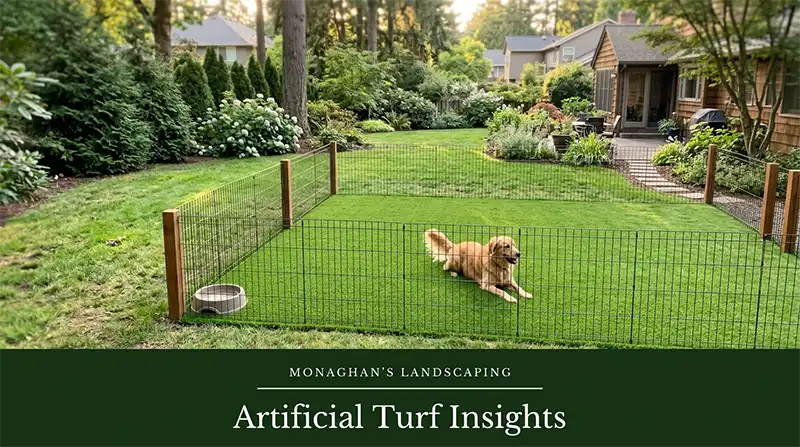
Artificial turf is one of the most popular choices for Portland dog owners because it eliminates mud, stays green without watering, and is easy to clean. But pet waste does require attention.
Solid waste: Pick up immediately, same as you would on natural grass. The turf surface cleans up easily, but leaving waste on the surface allows bacteria to work into the infill.
Urine: On natural grass, urine causes burn spots. On turf, it doesn’t discolor the fibers, but it can create odor if it accumulates in the infill, especially during Portland’s warm summer months when evaporation concentrates the residue. Rinse urine areas with a hose weekly. For yards with multiple dogs or heavy use, a monthly application of an enzyme-based turf deodorizer breaks down the organic compounds that cause odor.
Infill choice matters: If you’re installing new turf specifically for a dog yard, antimicrobial infill (like ZeoFill or BioFill) resists odor better than standard crumb rubber or silica sand. We can recommend the right infill for pet use during the consultation.
What Not to Do
Don’t use a pressure washer at close range. High-pressure water can dislodge infill, damage the turf backing, and separate seams. If you need to deep-clean the surface, use a garden hose with a standard spray nozzle.
Don’t park vehicles on residential turf. Artificial turf is designed for foot traffic, not tire weight. Vehicle tires crush the fibers permanently and can crack the backing. If you need a surface that handles vehicles, that’s a paver driveway project, not a turf application.
Don’t use herbicides or weed killer on turf. Weeds don’t grow through properly installed turf (the weed barrier beneath it prevents that). If weeds appear at the edges where the turf meets beds or hardscape, pull them by hand or spot-treat the adjacent soil, not the turf surface.
Don’t ignore drainage issues. If water consistently pools on the turf surface, the problem is underneath: either the base wasn’t graded properly during installation, the drainage aggregate has settled, or the turf’s drainage holes are blocked. Surface maintenance won’t fix a subsurface drainage problem. Call us and we’ll assess it.
How Long Does Artificial Turf Last?
Quality artificial turf with proper installation and maintenance lasts 15 to 20 years in Portland before the fibers wear enough to warrant replacement. The backing and drainage system last longer than the surface fibers. UV degradation (fading and fiber brittleness from sun exposure) is the primary wear factor, but Portland’s overcast climate actually extends turf lifespan compared to sunnier regions. Portland turf gets roughly 40% less UV exposure annually than turf in Phoenix or Southern California.
The maintenance described here is the difference between hitting the 15-year mark and the 20-year mark.
Call (503) 847-9110 or request your free estimate online.
Learn More About Artificial Turf
Can You Install Artificial Turf Over an Existing Lawn or Concrete? — What needs to happen underneath before turf goes down.
Is Artificial Turf Better for the Environment Than Natural Grass? — An honest look at the tradeoffs.
How Much Does Artificial Turf Cost in Portland? — 2026 pricing by project size and turf type.
Artificial Turf vs. Natural Grass for Portland Yards — Side-by-side comparison of cost, maintenance, and performance.
Does Artificial Turf Get Hot? — What Portland homeowners should know about heat and turf.