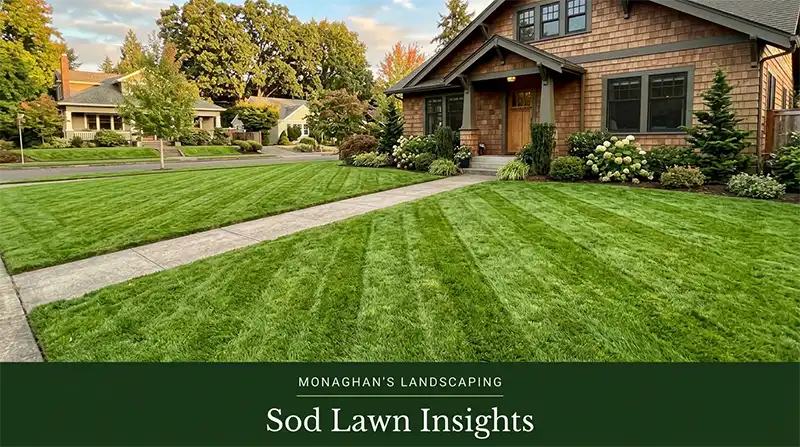
The grass blend in your sod determines how the lawn looks, how it handles Portland’s rain and shade, how much water it needs in summer, and how well it roots into clay soil. Choosing the wrong blend means fighting the lawn instead of enjoying it. For a full overview of how we approach sod projects, see our sod lawn installation page.
Here’s how the most common sod types for the Portland area compare and which situations each one fits best.
Perennial Ryegrass
Perennial ryegrass is the dominant grass species in Portland-area sod. It germinates fast, establishes quickly, and produces a dense, fine-textured lawn with a deep green color. Most sod from Willamette Valley growers is predominantly perennial ryegrass or a ryegrass-dominant blend.
Why it works in Portland: Perennial ryegrass thrives in Portland’s mild, wet climate. It’s a cool-season grass that grows actively during the spring and fall when Portland gets most of its rain, and it stays green through winter when warm-season grasses go dormant. It roots aggressively into amended soil, which matters on Portland’s clay because the faster the roots establish, the better the lawn survives its first wet season.
Best for: Full-sun to partial-shade lawns, high-traffic areas (it recovers well from foot traffic), and homeowners who want the classic dense, green lawn look. This is the default recommendation for most Portland front and backyards.
Limitations: Perennial ryegrass needs moderate water during Portland’s dry summer months (July through September). Without irrigation or consistent manual watering, it goes dormant and turns brown in August. It also thins in heavy shade, so yards with dense tree canopy need a shade-tolerant blend.
Fine Fescue
Fine fescue is a group of grass species (creeping red fescue, chewings fescue, hard fescue, and sheep fescue) that are thinner-bladed, more shade-tolerant, and lower-maintenance than ryegrass. Fine fescue is rarely sold as a pure sod but is commonly blended with perennial ryegrass in Portland-area sod mixes.
Why it works in Portland: Fine fescue fills the gaps where ryegrass struggles: shade, dry spots, and areas where you don’t want to water heavily. It requires less fertilizer and less irrigation than ryegrass, making it a lower-input grass that still stays green through most of Portland’s year. The OSU Extension guide for Western Oregon lawns recommends perennial ryegrass and fine fescue blends as the standard for the region.
Best for: Shaded yards under mature trees (common in Laurelhurst, Eastmoreland, and Lake Oswego), low-traffic areas where a softer texture is acceptable, and homeowners who want a lawn that survives Portland’s dry summers with minimal watering.
Limitations: Fine fescue doesn’t handle heavy foot traffic as well as ryegrass. It also grows more slowly, so recovery from wear or damage takes longer. In full sun with regular watering, ryegrass will outcompete fine fescue over time, which is why they’re blended rather than planted separately.
Perennial Ryegrass / Fine Fescue Blend
This is the standard Portland lawn sod. A blend of roughly 60-70% perennial ryegrass and 30-40% fine fescue gives you the best of both species: the fast establishment, density, and traffic tolerance of ryegrass with the shade tolerance, drought resilience, and lower maintenance requirements of fine fescue.
Why it works in Portland: Portland yards aren’t uniform. Most have a mix of sun and shade, with conditions that change through the day and across seasons as the sun angle shifts. A blended sod adapts because each species fills the niche where it performs best. The ryegrass dominates the sunny areas, the fine fescue dominates the shady spots, and the lawn as a whole stays thick and green across the entire yard.
Best for: The majority of Portland residential lawns. Unless your yard is all shade, all sun, or has a specific performance requirement, the standard blend is the right choice. It’s what we install on most projects.
Turf-Type Tall Fescue
Turf-type tall fescue is a different species from fine fescue. It has a wider blade, deeper root system, and higher heat and drought tolerance than perennial ryegrass. Older varieties of tall fescue were coarse and clumpy, but modern turf-type cultivars have been bred for finer texture and denser growth.
Why it works in Portland: Tall fescue’s deep roots (12+ inches compared to 6-8 inches for ryegrass) make it the most drought-tolerant cool-season grass available. It stays green longer into Portland’s dry summer without irrigation. Its deeper root system also penetrates clay soil more effectively, which helps with long-term stability on compacted sites.
Best for: Homeowners who don’t have a sprinkler system and don’t want to water manually through July, August, and September. Properties in Beaverton, Tigard, and Hillsboro where summer heat exposure is higher than in Portland’s tree-canopied inner neighborhoods. Yards with compacted clay where ryegrass struggles to root deeply.
Limitations: Turf-type tall fescue sod is less commonly stocked by Willamette Valley growers than the standard ryegrass/fescue blend, so it may need to be ordered in advance. The wider blade texture looks different from a traditional Portland lawn, which is a preference issue, not a performance issue. It also doesn’t blend as cleanly with existing ryegrass lawns if you’re resodding only a section of the yard.
Kentucky Bluegrass
Kentucky bluegrass is the default lawn grass in most of the United States, but it’s not the best choice for Portland. It’s included here because homeowners often ask about it.
Why it’s not ideal for Portland: Kentucky bluegrass requires significantly more water than ryegrass or fescue to stay green through Portland’s dry summer. It’s also more susceptible to fungal diseases in Portland’s wet, mild fall and winter conditions. It establishes more slowly than ryegrass, and on Portland’s clay soil, its shallower root system doesn’t anchor as effectively. Some Portland sod blends include a small percentage of Kentucky bluegrass for its self-repairing rhizome growth (it can fill small gaps from underground runners), but it shouldn’t be the primary species.
Best for: Only as a minor component (10-15%) in a blend with ryegrass for its gap-filling ability. Not recommended as a primary sod species in Portland.
How to Choose the Right Sod for Your Yard
Mostly sunny, moderate traffic, sprinkler system available: Standard perennial ryegrass/fine fescue blend. This is the default and it works for 80% of Portland yards.
Heavy shade from mature trees: A shade-dominant blend with a higher percentage of fine fescue (50%+). Ask the grower or your installer to specify a shade mix.
No irrigation and you don’t want to water in summer: Turf-type tall fescue. It’ll stay green longer without water than any other cool-season option.
High-traffic yard (kids, dogs, heavy use): Ryegrass-dominant blend. Ryegrass recovers from wear faster than any other cool-season species available in Portland sod.
Replacing a section of an existing lawn: Match the existing blend as closely as possible. If the existing lawn is the standard ryegrass/fescue mix, don’t patch with tall fescue or it’ll look like two different lawns.
We evaluate sun, shade, soil, drainage, and intended use during every free on-site consultation and recommend the right sod blend for your specific conditions. The sod is ordered directly from Willamette Valley growers and installed the same day it’s harvested.
Call (503) 847-9110 or request your free estimate online.
Learn More About Sod Installation
How Much Does Sod Installation Cost in Portland? — 2026 pricing by lawn size, soil prep, and what drives cost.
How to Prepare Your Yard for Sod in Portland — Why soil prep on clay matters more than the sod itself.
Sod vs. Seed: Which Is Better for Portland Lawns? — Cost, timeline, and success rate comparison.
When Is the Best Time to Install Sod in Portland? — Month-by-month breakdown of sod installation timing.
How to Care for New Sod in Portland — Watering schedules, first mow timing, and what to watch for during establishment.