
If you’ve been researching drainage solutions for your Portland property, you’ve probably come across French drains, catch basins, and maybe E-Z Flow systems. All three solve drainage problems, but they solve different types of drainage problems. Installing the wrong one wastes money. Installing the right one (or the right combination) fixes the issue permanently.
Here’s how each system works, when to use it, and how they compare on Portland’s clay soil.
French Drains: Intercepting Subsurface Water
How They Work
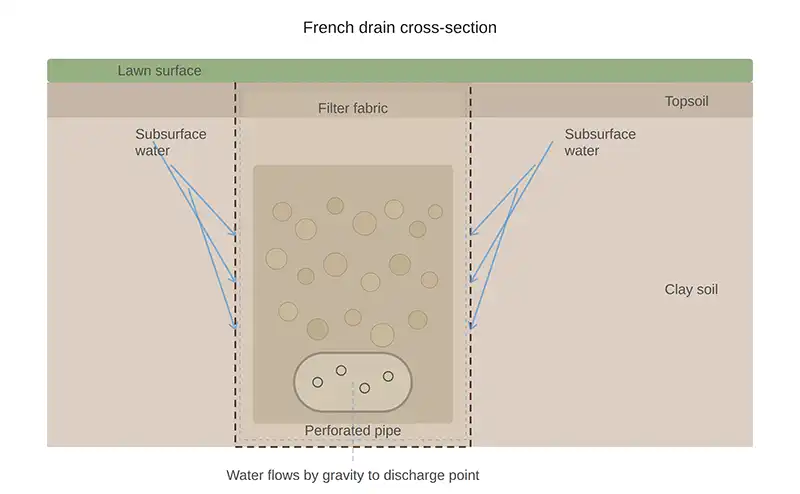
A French drain is a gravel-filled trench with a perforated pipe at the bottom. Water saturating the surrounding soil seeps through the gravel, enters the pipe through the perforations, and flows by gravity to a discharge point. The trench is lined with filter fabric to prevent clay and silt from clogging the system over time.
Best For…
French drains excel at intercepting water that’s moving through the soil underground. They’re the right choice when your yard stays soggy even after the rain stops, when water is seeping toward the foundation through saturated clay, or when a slope is channeling subsurface water downhill into the house or lawn area. On Portland’s clay soil, French drains are the most commonly installed drainage system because clay traps water underground where surface solutions can’t reach it.
Limitations
French drains don’t handle surface runoff well. Water sheeting across a patio or pooling in a visible depression won’t enter a buried French drain efficiently because the water needs to percolate through soil and gravel to reach the pipe. If your problem is surface water, you need a catch basin or grading correction instead of (or in addition to) a French drain.
Portland Considerations
Clay soil is both why French drains are necessary in Portland and why they need to be installed correctly. The filter fabric must fully wrap the gravel to prevent clay infiltration, the gravel must be clean and washed (not crushed fines that pack tight), and the pipe must be pitched consistently to the discharge point. We install French drains on properties across the metro, from flat Clackamas lots to steep grades in West Linn and the West Hills
Cost Range
$1,500 to $6,000+ depending on length, depth, and discharge routing. For a detailed breakdown, see our French drain cost guide.
Catch Basins: Collecting Surface Water
How They Work
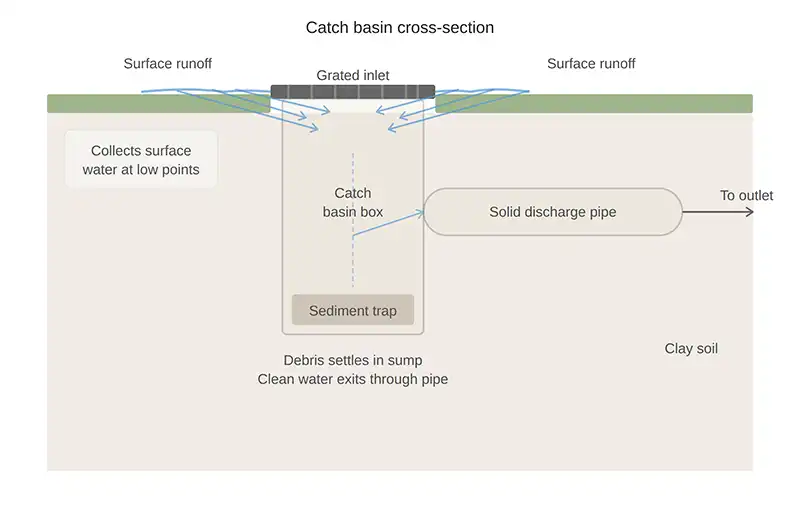
A catch basin is a grated box installed at ground level in a low spot. Surface water flows across the ground, enters the grate, drops into the box, and exits through a solid (non-perforated) pipe that routes it to a discharge point. The box typically includes a sump at the bottom that traps sediment and debris before they enter the pipe.
Best For…
Catch basins are the right solution when water pools visibly on the surface: at the base of a driveway, alongside a patio or walkway, in a lawn depression, or at the bottom of a slope where runoff concentrates. They’re point-collection devices, meaning they grab water at a specific spot and send it away. Most Portland properties with both surface pooling and subsurface saturation need catch basins and French drains working together as a combined system.
Limitations
Catch basins only collect water that flows to them across the surface. They don’t intercept water moving through the soil underground. If your yard stays spongy and saturated even without visible puddles, a catch basin won’t solve the problem because the water never reaches the grate. You need a French drain for subsurface water.
Portland Considerations
Catch basins in Portland need regular maintenance because leaves, pine needles, and organic debris accumulate on the grate during fall and winter. A clogged grate defeats the purpose of the basin. We install basins with removable grates for easy cleaning and size the sump to handle Portland’s debris load. Positioning is critical: the basin needs to sit at the actual low point where water collects, which isn’t always where it looks like it should be. We verify low points with a level during the site assessment. Catch basins are especially common on properties in Happy Valley and Damascus where newer construction grading creates concentrated runoff points between lots.
Cost Range
$800 to $3,000 per basin including pipe routing to the discharge point. Multiple basins on a single property are connected to a shared discharge line, which reduces per-basin cost.
E-Z Flow Drains: The Lightweight Alternative
How They Work
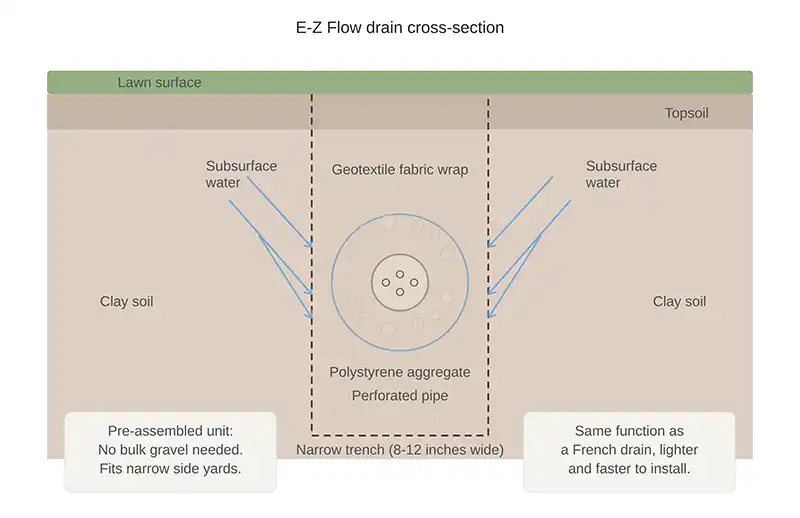
E-Z Flow is a pre-assembled drainage pipe surrounded by polystyrene aggregate and wrapped in geotextile fabric. It functions the same way as a French drain, intercepting subsurface water and routing it to a discharge point. The difference is that the aggregate and fabric come pre-assembled around the pipe, eliminating the need to trench wide, haul bulk gravel, and hand-wrap filter fabric.
Best For…
E-Z Flow is the right choice when you need a French drain’s functionality in a space where a traditional French drain is impractical. Narrow side yards between houses, runs along fence lines, trenches through established garden beds, and areas with limited access for equipment and gravel delivery are all strong E-Z Flow candidates. The narrower trench and lighter materials mean faster installation and less disruption to existing landscaping.
Limitations
E-Z Flow has less total drainage capacity than a traditional gravel-filled French drain of the same length because the polystyrene aggregate displaces less water volume than a full gravel bed. For high-volume applications like foundation perimeter drains, long runs intercepting a hillside, or drains behind retaining walls, a traditional French drain with gravel is the stronger choice. E-Z Flow is a fit-for-purpose solution, not a universal replacement.
Portland Considerations
E-Z Flow works well in the tight lot layouts common in older Portland neighborhoods like Sellwood, Hawthorne, Laurelhurst, and the inner eastside, where properties sit close together and side yards are often only 3 to 5 feet wide. The pre-wrapped fabric holds up well against Portland’s clay as long as the pipe is pitched correctly and the discharge point stays clear.
Cost Range
$1,200 to $3,500 depending on length and discharge routing. Generally 15 to 25% less than a comparable traditional French drain because of reduced excavation and material handling.
Which System Do You Need?
The answer depends on what type of water problem you have and where it’s coming from.
Your yard stays soggy and spongy even after the rain stops. The water is underground in saturated clay. You need a French drain or E-Z Flow drain to intercept it below the surface.
Water pools visibly in specific low spots after rain. The water is on the surface with nowhere to go. You need a catch basin at the low point, possibly with grading corrections to direct surface flow toward the basin.
Water is reaching your foundation. This is usually a combination problem: improper grading directing surface water toward the house, plus saturated clay pushing subsurface water against the foundation walls. The fix typically involves regrading, a French drain along the foundation, and downspout routing into underground pipe.
You have a narrow side yard that stays wet. E-Z Flow is the practical choice here. A traditional French drain would require a wider trench than the space allows.
Your patio or driveway has water pooling at the edge. Catch basin or channel drain at the low edge, with pipe routing to a discharge point.
You have multiple problems. Most Portland properties do. A soggy lawn, a pooling patio, and a damp foundation are three symptoms of the same underlying issue: water on the property with no designed path to leave. The solution is a combined system with French drains handling subsurface water, catch basins handling surface water, grading directing flow to the right places, and solid pipe routing everything to a discharge point.
Why the Right Diagnosis Matters More Than the Right Product
The most expensive mistake in drainage work isn’t choosing the wrong pipe. It’s installing a system that treats the symptom instead of the cause. A catch basin in a soggy lawn won’t help because the water is underground. A French drain next to a pooling patio won’t help because the water is on the surface. The diagnosis determines the solution, and the diagnosis requires walking the property and watching where water actually goes.
We provide free on-site drainage assessments throughout the Portland metro. We’ll identify what type of water problem you have, where it’s coming from, and which combination of systems will fix it. You’ll get a detailed written estimate with line-item pricing before any work begins.
Call (503) 847-9110 or request your free estimate online.
Learn More About Drainage
How Much Does a French Drain Cost in Portland? — 2026 pricing by project type and what drives cost.
5 Signs Your Portland Yard Has a Drainage Problem — How to identify drainage issues before they cause serious damage.
Do You Need a Permit for Drainage Work in Portland? — What triggers a permit and who handles it.
Can You Install a French Drain Yourself? — What’s involved, what goes wrong, and when to hire a pro.
Backyard Drainage and Grading Guide — How to evaluate your yard and understand your options.