
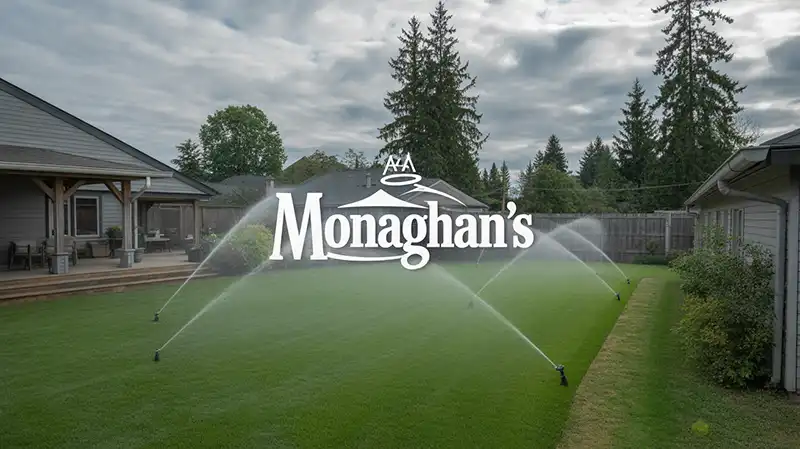
There’s no single sprinkler type that works for every area of a Portland yard. Lawns, ornamental beds, foundation plantings, vegetable gardens, and slopes each have different watering needs, and the right head type for each depends on area size, plant type, sun exposure, and soil conditions. Most residential systems in Portland use a combination of 2 to 3 head types across different zones. You can see our full approach to sprinkler system design and installation on our service page.
Here’s how each type works and where it fits on a Portland property.
Rotary Heads (Gear-Driven Rotors)
Rotary heads deliver a single stream of water that rotates in a circle, covering a large area slowly and evenly. They’re available in adjustable arc models (for corners and edges) and full-circle models (for center-of-lawn placement). Throw radius ranges from 15 to 45 feet depending on the nozzle.
Application rate: 0.4 to 0.8 inches per hour. This is the key advantage in Portland. Clay soil absorbs water at roughly 0.2 to 0.5 inches per hour. Rotary heads apply water slowly enough that it soaks in instead of running off. On Portland clay, rotary heads are more efficient than spray heads for any lawn area large enough to warrant them.
Best for: Open lawn areas 15 feet wide or wider. Front yards, backyards, side yards with enough width for the throw pattern. The primary lawn irrigation head for most Portland residential systems.
Limitations: The minimum throw radius (about 15 feet) means rotary heads don’t work in narrow strips, small beds, or tight spaces between the house and fence. They also need consistent water pressure (40 to 65 PSI) to rotate properly. Low-pressure systems may need a booster or should use spray heads instead.
Pop-Up Spray Heads
Pop-up sprays deliver a fixed fan pattern of water in a set arc (quarter circle, half circle, full circle, or adjustable). They pop up from the ground when the zone activates and retract flush when off. Throw radius ranges from 4 to 15 feet.
Application rate: 1.2 to 2.0 inches per hour. This is significantly faster than clay can absorb. On Portland clay, spray heads need to be programmed with cycle-and-soak schedules (short runs with pauses between) to prevent runoff. Without this programming, most of the water applied by spray heads on Portland clay runs off the surface before it soaks in.
Best for: Small lawn areas under 15 feet wide (parking strips, narrow side yards, small courtyard lawns), garden beds with low ground cover that benefits from overhead watering, and areas where the throw distance of a rotary head would overspray onto sidewalks, driveways, or buildings.
Limitations: Higher application rate causes runoff on clay without cycle-and-soak. More susceptible to wind drift (the fine spray pattern gets carried by wind, wasting water and creating uneven coverage). Higher evaporation loss than rotary heads because of the finer droplet size. Uses more water per square foot of coverage than rotary heads.
Drip Irrigation
Drip irrigation delivers water slowly through emitters placed directly at the base of each plant or along a drip line running through a bed. Water goes straight to the root zone with minimal surface wetting, evaporation, or runoff.
Application rate: 0.5 to 2 gallons per hour per emitter, applied directly to the soil at the plant base. There’s essentially zero runoff because the water goes exactly where it’s needed at a rate the soil can absorb.
Best for: Ornamental beds, foundation plantings, shrub borders, raised beds, vegetable gardens, container areas, and any planting bed where overhead spray would wet the foliage. In Portland, drip is especially valuable for plants susceptible to fungal problems (roses, hydrangeas, many perennials) because it keeps the leaves dry. Wet foliage during Portland’s humid summer evenings promotes powdery mildew, black spot, and other fungal diseases that overhead watering exacerbates.
Limitations: Drip lines and emitters can clog if the water source has sediment or mineral content. A filter on the drip zone supply line prevents this. Drip emitters are also invisible once installed (buried under mulch), which makes it easy to accidentally cut or damage them during bed maintenance. Drip doesn’t work for lawn areas because the coverage pattern is too localized for even grass coverage.
Micro-Spray
Micro-spray heads are small, low-volume sprinklers mounted on short stakes in planting beds. They deliver a fine spray pattern with a throw radius of 3 to 10 feet. They’re a hybrid between drip (low volume, targeted) and spray heads (overhead coverage pattern).
Application rate: 0.4 to 1.0 inches per hour. Moderate rate that works well on Portland clay without excessive runoff.
Best for: Ground cover beds, wide planting areas where drip would require too many individual emitters, and areas where the plants are closely spaced and the root zones overlap. Also useful for newly planted areas where the root systems haven’t spread yet and the plants need broader coverage than individual drip emitters provide.
Limitations: The small spray pattern is affected by wind. Micro-spray also wets foliage, which shares the fungal risk of spray heads on susceptible plants. On established ornamental beds where plants are well-rooted and spaced, drip is usually more efficient.
Which Type for Each Area of a Portland Yard
Front lawn: Rotary heads. The front yard is typically the largest open lawn area and benefits from the even, slow application rate. Rotary coverage reaches across the full width without overspray onto the sidewalk or street if head placement and arc adjustment are done correctly.
Backyard lawn: Rotary heads if the area is 15+ feet wide. Pop-up sprays if the backyard is small or narrow. Many Portland backyards are partially covered by patio, deck, or beds, leaving a smaller lawn area that sprays cover more efficiently than rotors.
Parking strip: Pop-up sprays. Parking strips are typically 4 to 8 feet wide, too narrow for rotary heads. Short-throw spray heads on risers or pop-ups cover the strip without throwing water onto the street or sidewalk. If the parking strip has drought-tolerant plantings instead of grass, drip is the better option.
Foundation plantings: Drip. Shrubs and perennials along the house foundation need root-zone watering without wetting the siding or foundation wall. Drip delivers water exactly where it’s needed and keeps the house dry.
Ornamental beds: Drip for established beds with spaced plantings. Micro-spray for dense ground cover or newly planted beds. Either option is better than overhead spray for bed maintenance because it keeps mulch in place and foliage dry.
Slopes: Drip or micro-spray with cycle-and-soak programming. Overhead spray on slopes causes runoff that erodes mulch, washes out plantings, and wastes water. Drip applies water slowly enough to prevent runoff entirely. Properties in West Linn, Lake Oswego, and the West Hills with sloped beds benefit significantly from drip over spray. If slope erosion is already a problem, drainage work may be needed before irrigation addresses the watering issue.
Vegetable garden: Drip on a timer. Drip delivers consistent, measured water to each plant without wetting the foliage (reducing disease pressure) and without wasting water between rows. Many Portland gardeners who hand-water through the summer switch to drip after experiencing the consistency and time savings.
Combining Types on One System
A typical Portland residential system uses rotary heads on 2 to 3 lawn zones, pop-up sprays on 1 to 2 small lawn or parking strip zones, and drip on 2 to 4 bed zones. Each type runs on its own zone because the application rates differ and the run times need to be programmed independently. Mixing head types on the same zone creates uneven watering (the sprays dump 1.5 inches per hour while the rotors apply 0.5 inches, so the spray area gets triple the water).
We design the zone layout during the free on-site consultation, matching head types to each area based on size, plant type, sun exposure, and soil conditions. The result is a system that waters every area at the right rate with the right method.
Call (503) 847-9110 or request your free estimate online.
Learn More About Sprinkler Systems
Commercial Sprinkler System Installation in Portland — What makes commercial irrigation different from residential.
How Portland’s Climate Affects Sprinkler System Design — Why systems here need to handle both drought and deluge.
How Much Does a Sprinkler System Cost in Portland? — 2026 residential pricing by yard size and system complexity.
When Is the Best Time to Install a Sprinkler System? — Seasonal timing and why it matters for Portland soil.
Do You Need a Permit for a Sprinkler System in Portland? — Backflow requirements, permits, and what your installer handles.