
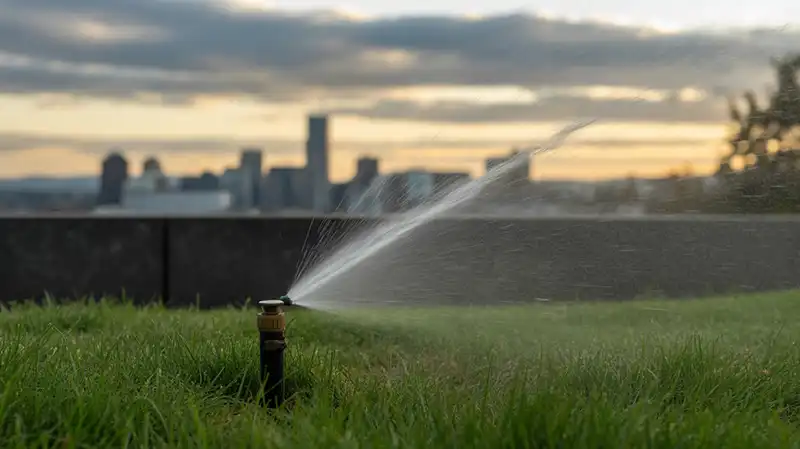
Portland’s climate creates a paradox for irrigation. The city gets 43+ inches of rain annually, but almost all of it falls between October and May. July and August average less than 1 inch combined. A lawn or landscape that’s drowning in November is drought-stressed by August. That seasonal swing drives every design decision in a Portland sprinkler system. Here’s a closer look at our full sprinkler system installation approach.
The Two Seasons That Matter
The Dry Season (July Through September)
This is when the sprinkler system earns its keep. Portland averages 0.5 to 1 inch of rain total across July and August. Lawns need 1 to 1.5 inches of water per week to stay green. Without irrigation, cool-season grasses (perennial ryegrass and fine fescue, the standard Portland lawn) go dormant and turn brown by mid-July. They’ll recover when fall rain arrives, but most homeowners don’t want a brown lawn for 2 to 3 months.
The dry season also stresses ornamental plantings, newly installed landscapes, and trees. Established trees are usually fine because their roots access deep moisture, but anything planted within the last 1 to 2 years depends on supplemental water to survive its first or second Portland summer.
The Wet Season (October Through May)
During the rainy months, the sprinkler system should be off entirely or running only on rare dry stretches. Portland receives 3 to 6 inches of rain per month from October through March. Running sprinklers on top of that wastes water, oversaturates clay soil, promotes fungal disease in turf, and increases water bills with zero benefit.
A properly designed Portland sprinkler system includes a rain sensor or a smart controller with weather integration that automatically suspends watering when rainfall is adequate. This isn’t a nice-to-have feature in Portland. It’s essential. A system without rain sensing runs on its programmed schedule regardless of weather, which means it waters during every rainstorm from October through May.
How Climate Shapes System Design
Zone Layout Based on Exposure
Portland yards have dramatic variation in sun and shade, often within the same property. A south-facing front yard in full sun may need 1.5 inches of water per week in July. A north-facing backyard shaded by mature Douglas firs may need 0.5 inches. Putting both on the same zone wastes water on the shaded area and under-waters the sunny area.
We design zones based on sun exposure, plant type, and soil conditions rather than just proximity. Sunny lawn areas get their own zones with higher run times. Shaded lawn areas get separate zones with shorter runs. Ornamental beds get drip zones that deliver water slowly to the root zone without wetting the foliage (wet foliage in Portland’s humid summer evenings promotes powdery mildew and other fungal problems).
Head Selection for Portland Conditions
Rotary heads are used on larger lawn areas (15+ feet of throw radius). They apply water slowly and evenly, which is important on Portland’s clay soil because clay absorbs water slowly. A spray head that dumps 1.5 inches per hour overwhelms the clay surface. The water runs off instead of soaking in. Rotary heads that apply 0.4 to 0.6 inches per hour give the clay time to absorb each pass.
Pop-up spray heads work for smaller lawn areas and garden beds where the throw distance is under 15 feet. In Portland, spray heads should be paired with pressure-regulated bodies to prevent misting (fine droplets that evaporate before reaching the ground), which wastes water and provides uneven coverage.
Drip irrigation is the most efficient option for ornamental beds, foundation plantings, container areas, and vegetable gardens. Drip delivers water directly to the root zone with minimal evaporation loss. In Portland’s dry summer, drip-irrigated beds use 30 to 50% less water than beds watered with overhead spray heads.
Soil-Specific Programming
Portland’s clay soil absorbs water at roughly 0.2 to 0.5 inches per hour depending on compaction and amendment. If the sprinkler system applies water faster than the clay can absorb it, the excess runs off into the street, down slopes, or pools in low spots. None of that water reaches the root zone.
The solution is cycle-and-soak programming. Instead of running a zone for 20 minutes straight, the controller runs it for 7 minutes, pauses for 15 minutes (allowing the water to soak into the clay), then runs another 7 minutes. Three short cycles deliver the same total water with dramatically better absorption on clay. Most smart controllers support cycle-and-soak natively. We program it during system setup based on measured soil absorption rates on your property.
Winterization Considerations
Portland winters are mild compared to the Midwest or Northeast. The ground rarely freezes below 2 to 3 inches, and sustained hard freezes are infrequent (Portland averages 5 to 10 days per year below 32°F). This means Portland sprinkler systems don’t require the aggressive blowout procedures used in cold climates.
However, above-ground components (backflow prevention devices, exposed pipe runs, valve boxes in unprotected locations) can freeze and crack during Portland’s occasional cold snaps. We install backflow devices with insulated covers and route pipe below the frost line (12 to 18 inches in Portland) wherever possible. For exposed components that can’t be buried, we recommend draining or wrapping them before December.
Smart Controllers and Weather Integration
A smart controller adjusts watering schedules automatically based on local weather data, soil moisture, and evapotranspiration rates. In Portland, this means the system reduces or eliminates watering during the rainy season without manual intervention, increases watering during the dry July and August weeks, and adjusts for unusual weather patterns (an early dry spell in June, a late-season rain event in September).
Smart controllers connect to local weather stations via WiFi. Portland has excellent weather data coverage through NOAA stations and private weather networks. The controller checks conditions daily and adjusts the schedule before each run. Over a full year in Portland, a smart controller typically saves 30 to 50% on water use compared to a fixed-schedule timer, simply by not watering when rain is providing what the landscape needs.
Common Portland Design Mistakes
One zone for the entire yard. A single zone can’t account for sun vs. shade, lawn vs. beds, or clay vs. amended soil. The result is over-watering in some areas and under-watering in others. Minimum zone count for a typical Portland residential property is 4 to 6, even on small lots.
Spray heads on slopes. Spray heads apply water faster than clay can absorb it, and gravity pulls the excess downhill. Slopes need drip irrigation or rotary heads with cycle-and-soak programming to keep water where it’s needed instead of at the bottom of the hill.
No rain sensor. A system that runs on a fixed schedule year-round in Portland wastes thousands of gallons during the rainy season. Rain sensors cost $30 to $80 and pay for themselves in the first winter.
Shallow trenching on clay. Pipe buried only 4 to 6 inches deep in clay soil can be exposed by erosion, damaged by aeration equipment, or pushed upward by freeze-thaw cycles. Portland sprinkler pipe should be buried 8 to 12 inches deep.
Designing for Portland’s Climate
A sprinkler system that works well in Portland is designed for the dry season and smart enough to stay off during the wet season. It applies water slowly enough for clay to absorb it, separates zones by exposure and plant type, and adjusts automatically to Portland’s variable weather. If your existing system runs on a fixed schedule, dumps water faster than your clay can absorb it, or waters during rainstorms, it’s working against Portland’s climate instead of with it.
We design and install sprinkler systems specifically for Portland’s conditions. The free on-site consultation includes a soil and drainage assessment, sun exposure mapping, and a zone plan tailored to your property.
Call (503) 847-9110 or request your free estimate online.
Learn More About Sprinkler Systems
Commercial Sprinkler System Installation in Portland — What makes commercial irrigation different from residential.
Types of Sprinkler Systems for Portland Properties — Rotary heads, pop-ups, drip, and micro-spray compared.
How Much Does a Sprinkler System Cost in Portland? — 2026 residential pricing by yard size and system complexity.
When Is the Best Time to Install a Sprinkler System? — Seasonal timing and why it matters for Portland soil.
Do You Need a Permit for a Sprinkler System in Portland? — Backflow requirements, permits, and what your installer handles.