
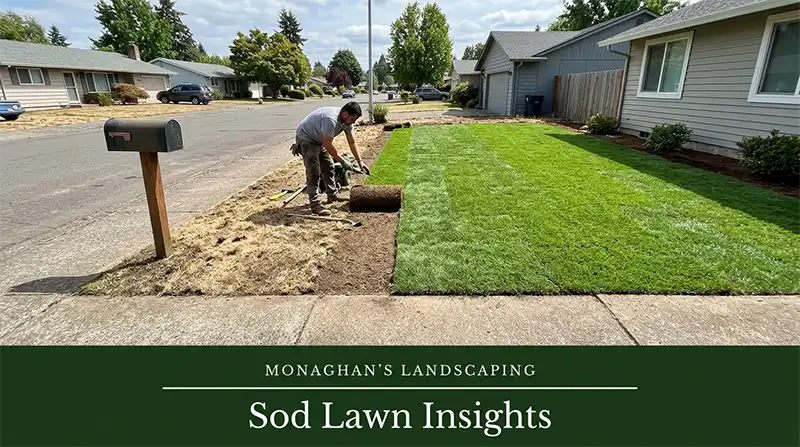
The sod itself is the easy part. It shows up on a truck from a Willamette Valley grower, gets laid in a day, and looks like a finished lawn by sundown. What determines whether that lawn is still healthy a year later is what happened to the soil before the sod arrived. For details on our full process, see our sod lawn installation page.
On Portland’s clay soil, soil preparation is the most important and most expensive part of a sod project. Here’s what needs to happen, why it matters, and what goes wrong when steps get skipped.
Step 1: Remove the Existing Lawn
The old turf has to come out completely. Laying new sod over old grass creates an organic layer between the new roots and the soil that blocks root penetration, traps moisture, and decomposes into a spongy mat that the new sod can’t anchor into.
We strip old lawns with a sod cutter, which slices under the grass at the root line and lifts it in rolls. The strips are loaded and hauled off site. After stripping, we rake the surface to remove remaining roots, debris, and any rocks larger than a golf ball that could prevent even contact between the new sod and the soil.
On Portland properties with lawns that have been in place for 10+ years, the organic thatch layer can be an inch or more thick. Stripping it down to bare mineral soil is the only way to give the new sod a direct path to root into the ground.
Step 2: Test and Evaluate the Soil
Once the old lawn is out, you can see what you’re working with. On most Portland properties, it’s clay. The question is how much amendment the clay needs to support healthy sod establishment.
The two things that matter most are drainage and compaction. Clay that’s been under a lawn for years is typically compacted from foot traffic, mowing, and the weight of saturated soil during the wet season. Compacted clay doesn’t let water drain through it and doesn’t let roots penetrate it. Both are problems for new sod.
A simple test: after stripping the old lawn, dig a hole 8 to 10 inches deep and fill it with water. If the water drains within 1 to 2 hours, the soil has reasonable percolation. If it’s still sitting there after 4 hours, the clay is too dense for sod roots to establish without significant amendment. Most Portland properties fall closer to the 4-hour end.
Step 3: Amend the Soil
This is the step that separates sod that thrives from sod that fails on Portland clay. Soil amendment means adding organic material to the existing clay to improve its structure, drainage, and nutrient content.
We spread 2 to 4 inches of blended topsoil (a mix of screened compost, sand, and loam) across the entire lawn area, then rototill it into the top 4 to 6 inches of existing clay. The result is a blended layer that drains better than raw clay, holds nutrients better than pure sand, and gives sod roots a medium they can actually grow through.
Why you can’t skip this step in Portland: Raw Portland clay holds moisture so effectively that new sod roots sit in waterlogged soil for months during the rainy season. Waterlogged roots develop fungal diseases, rot at the tips, and stop growing downward. The sod may look green on top for the first season, but the root system is shallow and weak. By the following summer, the lawn can’t access deep moisture and dies in patches. Soil amendment prevents this by creating a transition layer between the sod and the clay that drains enough to keep roots healthy through winter but retains enough moisture to sustain them through summer.
The volume of amendment needed depends on the clay density. Heavy, compacted clay on a property in Beaverton or Clackamas that’s been under an old lawn for 20 years needs more amendment than a newer property in Happy Valley where the builder brought in topsoil during grading. We assess this during the site visit and include the amendment quantity in the written estimate.
Step 4: Grade the Surface
After amendment, the soil surface needs to be shaped for two purposes: positive drainage away from the house and a smooth, even plane for the sod to lay flat on.
Drainage grading: The soil must slope away from the foundation at a minimum of 1% (about 1 inch of drop per 8 feet). Water that flows toward the house pools against the foundation and creates the same moisture problems that drainage systems are designed to solve. If the existing grade is flat or slopes the wrong direction, regrading during soil prep is the time to fix it, not after the sod is down.
Surface grading: The amended, rototilled soil is rough and uneven. We rake and level the surface to create a smooth plane with no humps, depressions, or abrupt grade changes. Low spots that trap water become dead spots in the lawn. Humps scalp when mowed. A properly graded surface is flat enough that a 2×4 laid across it makes contact along its full length.
If the lawn area has existing drainage issues (standing water, soggy patches that persist for days after rain), grading alone may not be enough. Some properties need French drains, catch basins, or downspout rerouting installed during the soil prep phase before sod goes down. Solving the drainage problem after sod installation means trenching through a finished lawn, so it’s always better to do it now. For more on evaluating drainage before a sod project, see our Drainage and Grading Guide.
Step 5: Compact and Final Prep
The amended, graded soil gets a light roll with a water-filled lawn roller. This firms the surface enough that the sod won’t sink into soft spots but keeps the soil open enough for root penetration. Over-compaction is as bad as no compaction: the goal is a surface that’s firm to walk on but gives slightly when you press your thumb into it.
After rolling, we do a final rake to smooth out any roller marks and check the grade one more time. The surface should be about 1 inch below the level of adjacent walkways, driveways, and bed edges. The sod adds that inch, bringing the finished lawn flush with the surrounding surfaces.
If the area has an existing sprinkler system, we check the head heights and adjust them to match the new finish grade. Heads that sit too low get buried by the sod and don’t spray correctly. Heads that sit too high become mower hazards.
Step 6: Irrigation Planning
New sod needs water immediately after installation and consistently for the first 2 to 3 weeks while roots establish. The watering schedule depends on the season, but during a typical Portland summer installation, the sod needs water twice a day for the first week, once a day for the second week, and every other day for the third week before transitioning to a normal schedule.
If you don’t have a sprinkler system, you’ll need to commit to this manual watering schedule or the sod will fail. We provide written aftercare instructions covering exact watering frequency and duration for the season your sod is installed. If you’re installing sod and a sprinkler system together, we coordinate both projects during the same soil work so the sprinkler trenches go in before the final grade and sod.
What Happens When Soil Prep Gets Skipped
We see the results of poor soil prep on Portland properties regularly. The same patterns repeat:
Sod that peels up easily after 4 to 6 weeks. The roots never penetrated the clay. Either the soil wasn’t amended (roots couldn’t push through) or the soil wasn’t rototilled deep enough (roots hit a clay hardpan at 2 inches and stopped).
Patches that die every summer. The root system is too shallow to access moisture below the surface. This happens when the amendment layer is too thin or was spread on top of the clay without tilling it in. The roots grow in the amendment layer but never reach the clay below, so they’re essentially growing in a few inches of potting mix on top of a concrete slab.
Standing water after rain. The grade wasn’t corrected during prep. Water pools in the same spots every time it rains, drowning the sod and creating bare patches that get worse each season.
Uneven surface and scalping when mowed. The soil wasn’t graded smooth enough before sod was laid. Humps and valleys are visible as soon as the first mow reveals the contour.
Every one of these failures is a soil prep problem, not a sod quality problem. The sod is almost always fine. The ground it was laid on wasn’t ready.
What Soil Prep Costs
Soil preparation typically accounts for 40 to 60% of the total sod installation cost on Portland clay. For a detailed pricing breakdown including prep, materials, and labor, see our sod installation cost guide.
The prep cost is why the cheapest sod installation bid is almost always the worst value. Contractors who undercut on price are usually skipping or shortcutting the soil amendment, grading, and drainage steps that determine whether the lawn survives. You get a green lawn for a few months and a dead lawn the following year.
How We Handle It
Every sod project we do starts with a free on-site soil and drainage assessment. We evaluate the clay density, compaction, existing grade, drainage patterns, sun and shade, and irrigation situation before recommending a soil prep plan. The written estimate specifies exactly how much amendment, what type of topsoil blend, and what grading work is included.
Call (503) 847-9110 or request your free estimate online.
Learn More About Sod Installation
How Much Does Sod Installation Cost in Portland? — 2026 pricing by lawn size, soil prep, and what drives cost.
Best Grass Types for Portland Lawns — Which sod blends perform best in Portland’s climate, shade, and soil conditions.
Sod vs. Seed: Which Is Better for Portland Lawns? — Cost, timeline, and success rate comparison.
When Is the Best Time to Install Sod in Portland? — Month-by-month breakdown of sod installation timing.
How to Care for New Sod in Portland — Watering schedules, first mow timing, and what to watch for during establishment.