
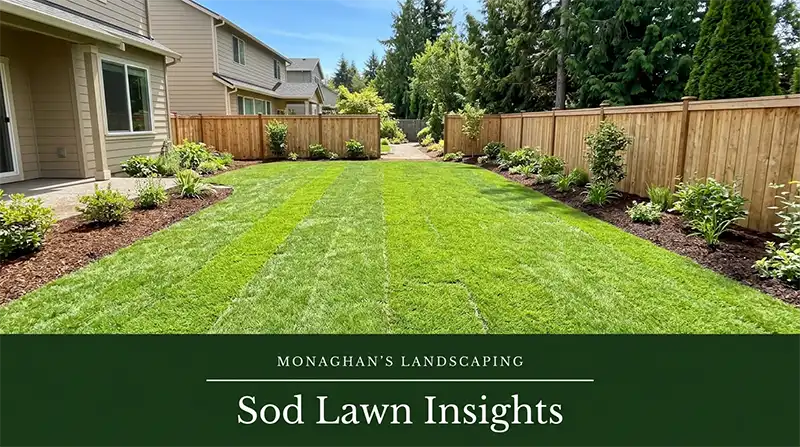
Sod gives you a finished lawn in a day. Seed costs less but takes months to fill in. Both can produce a healthy lawn in Portland, but they perform very differently on clay soil, handle Portland’s rain differently, and have different success rates depending on when you install them. Here’s our full breakdown of how we handle sod lawn projects if you want to see the process side.
Here’s a straight comparison to help you decide which approach makes sense for your property.
Establishment Time
Sod: Installed in one day. Walkable within 2 weeks. Fully rooted and mowable within 4 to 6 weeks. You go from bare dirt to a finished lawn between morning and evening.
Seed: Germination takes 7 to 21 days depending on grass species, soil temperature, and moisture. A usable lawn takes 2 to 3 months of growth. Full density may take a full growing season with overseeding to fill thin spots. The lawn can’t be walked on during the establishment period without damaging the young seedlings.
Verdict: If you need a functional lawn quickly (selling a home, hosting an event, kids and dogs need yard access), sod is the only realistic option. If you can wait 3+ months and keep everyone off the lawn during establishment, seed works.
Cost
Sod: $1.50 to $3.50 per square foot installed in Portland, including soil prep, sod material, and labor. A 2,000-square-foot lawn runs $3,000 to $7,000. For a full pricing breakdown, see our sod installation cost guide.
Seed: $0.50 to $1.50 per square foot including soil prep, seed, starter fertilizer, and straw or hydromulch cover. A 2,000-square-foot lawn runs $1,000 to $3,000. However, most seeded lawns need at least one round of overseeding ($200 to $600) to fill gaps, and some need a second round, which closes the cost gap.
Verdict: Seed costs roughly half as much upfront. After accounting for overseeding and the longer watering period, the gap narrows to about 30 to 40% less than sod. If budget is the primary constraint and you can accept the longer timeline, seed saves money.
Success Rate on Portland’s Clay Soil
Sod: High success rate when soil prep is done correctly. Sod arrives as a mature grass plant with an established root system. The roots need to grow into the amended soil, but the grass itself is already healthy and dense. It can tolerate Portland’s fall and winter rain immediately because the mature turf sheds water rather than being washed away by it.
Seed: More vulnerable on clay. Portland’s heavy rain can wash seed off sloped areas before it germinates. Clay soil crusts when it dries, forming a hard surface layer that seedlings struggle to push through. Seed that sits on saturated clay during a sustained rain event can rot before germinating. Success rate is highest on flat, well-amended soil installed in September or early October when temperatures are warm enough for germination but the heaviest rains haven’t started yet.
Verdict: Sod is more forgiving of Portland’s conditions. Seed can work but has a narrower window and requires more precise soil prep and timing. On slopes, sod wins decisively because seed washes downhill in the rain.
Seasonal Timing in Portland
Sod: Can be installed year-round in Portland. Spring and early fall are ideal because soil temperatures support fast rooting and you get natural rainfall to supplement watering. Summer installations work but require aggressive manual watering. Winter installations are possible but slower to root because of cool soil temperatures.
Seed: Has a much narrower window. The best time to seed in Portland is September through mid-October. Soil is still warm from summer (seed needs 50°F+ soil temperature to germinate), days are shortening (less evaporation stress), and fall rain is starting (natural irrigation). Spring seeding (March through May) is a secondary window but competes with weed germination and transitions into summer drought stress before the lawn is fully established.
Verdict: Sod gives you 8 to 10 months of viable installation window. Seed gives you about 6 weeks of ideal timing. If you miss the fall seeding window, you’re waiting until the following September or gambling on a spring attempt.
Weed Competition
Sod: Arrives as a dense, mature turf that physically blocks weed seeds from reaching the soil. As long as the sod is laid tight with no gaps between rolls, weeds have very little opportunity to establish during the rooting period. This is one of the biggest practical advantages of sod on Portland properties where weed pressure is high year-round.
Seed: A seeded lawn is essentially bare soil with scattered grass seeds, which is also the ideal environment for weed seeds. Every weed seed in the soil germinates alongside the grass seed, and you can’t apply broadleaf herbicide until the new grass is mature enough to tolerate it (typically 2 to 3 mowings). In Portland, where weed seeds are present in virtually every inch of residential soil, a seeded lawn almost always has significant weed competition during establishment.
Verdict: Sod suppresses weeds from day one. Seeded lawns fight weeds for the entire establishment period.
Variety Selection
Sod: You’re limited to whatever blends the Willamette Valley growers are growing that season. For most Portland lawns, this means perennial ryegrass/fine fescue blends and turf-type tall fescue. Specialty blends (shade-dominant mixes, specific cultivars) may need to be ordered in advance. For details on which grass types work best in Portland, see our sod selection guide.
Seed: You can buy any grass seed variety that’s available at Portland garden centers or through specialty suppliers. This gives you more control over the exact cultivar mix, the ratio of species, and the ability to blend for very specific conditions (deep shade, full sun, drought tolerance, traffic tolerance). If you want a lawn composed of a very specific mix that no grower stocks as sod, seed is the only path.
Verdict: Seed offers more variety selection. Sod covers the blends that work for 90%+ of Portland lawns but doesn’t offer the customization that seed does.
Erosion Control
Sod: Immediately stabilizes the soil surface. This is critical on slopes, around new construction, and on properties where bare soil would erode during rain. A sod lawn installed on a Tuesday will hold the hillside during a rainstorm on Wednesday.
Seed: Offers no erosion protection until the grass is dense enough to hold soil, which takes 2 to 3 months. Straw cover or hydromulch helps but doesn’t match the protection of established turf. On any slope steeper than about 10%, seed is a risk during Portland’s rainy season.
Verdict: For erosion-prone sites, sod is the only reliable option.
Which Should You Choose?
Choose sod if: You want a finished lawn immediately, your yard has slopes, you’re installing during any month other than September/October, you have clay soil that hasn’t been deeply amended, you have dogs or kids who need yard access, or you’re selling the home and need curb appeal fast.
Choose seed if: Budget is the primary constraint and you can wait 3 months for a usable lawn, you’re installing in September or early October on flat, well-amended soil, you want a very specific grass cultivar mix that’s not available as sod, or you’re overseeding an existing thin lawn rather than starting from scratch.
Consider a hybrid approach if: You have a large property and budget matters. Sod the high-visibility areas (front yard, areas visible from the patio) and seed the less visible areas (back corners, side yards). You get the instant impact where it counts and save money where it doesn’t.
We install sod lawns across the Portland metro area and can help you evaluate which approach fits your yard, timeline, and budget during the free on-site consultation.
Call (503) 847-9110 or request your free estimate online.
Learn More About Sod Installation
How Much Does Sod Installation Cost in Portland? — 2026 pricing by lawn size, soil prep, and what drives cost.
Best Grass Types for Portland Lawns — Which sod blends perform best in Portland’s climate, shade, and soil conditions.
How to Prepare Your Yard for Sod in Portland — Why soil prep on clay matters more than the sod itself.
When Is the Best Time to Install Sod in Portland? — Month-by-month breakdown of sod installation timing.
How to Care for New Sod in Portland — Watering schedules, first mow timing, and what to watch for during establishment.