
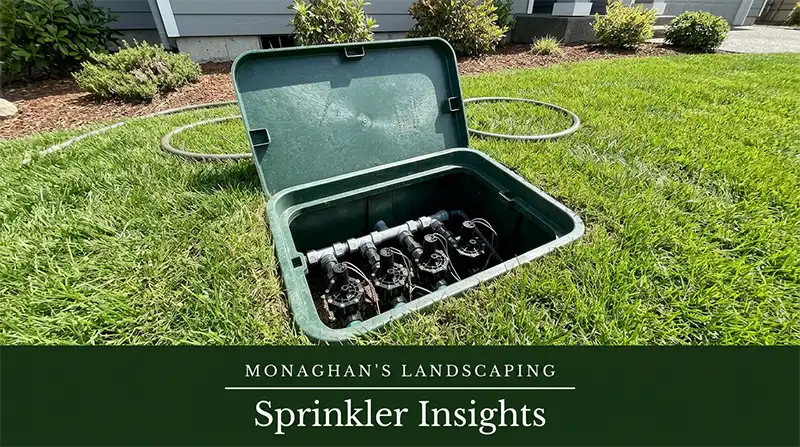
Most residential sprinkler system installations in Portland don’t require a plumbing permit for the irrigation work itself. However, the connection to the potable water supply triggers a backflow prevention requirement that’s enforced by the local water provider, and that requirement is non-negotiable regardless of permit status. Here’s what applies to your project and what we handle as part of every sprinkler system installation.
Backflow Prevention: Required on Every System
Any connection between a potable water supply and an irrigation system creates a potential cross-contamination risk. If water pressure drops (from a water main break, for example), irrigation water containing fertilizer, soil, or other contaminants could be siphoned back into the drinking water supply. Backflow prevention devices stop this from happening.
The Portland Water Bureau and all surrounding water providers (Tualatin Valley Water District, Lake Oswego Municipal Water, South Fork Water Board, Clackamas River Water) require an approved backflow prevention device on every irrigation connection. The most common device for residential sprinkler systems is a Reduced Pressure Zone (RPZ) assembly or a Pressure Vacuum Breaker (PVB).
RPZ assemblies are installed in-line and can be placed below the highest sprinkler head. They’re the most reliable backflow protection and are required when the irrigation system includes chemical injection (fertilizer through the system) or when the local water provider specifies RPZ.
PVB assemblies must be installed at least 12 inches above the highest sprinkler head in the system. They’re simpler and less expensive than RPZs but have the height requirement that sometimes makes placement difficult on sloped properties.
We install the appropriate device for your property’s configuration and coordinate with the water provider on the initial test and registration.
Annual Backflow Testing
After installation, the backflow device must be tested annually by a certified backflow tester. The water provider sends a notice each year and requires proof of a passing test. If the test isn’t completed, the water provider can shut off service. Annual testing costs $75 to $125 and takes about 15 minutes on-site.
We offer annual backflow testing for our clients. The test verifies that the internal check valves and relief valves in the device are functioning correctly. Most devices pass. If a component has failed (usually after 8 to 12 years), the repair is straightforward and the device is retested the same day.
When a Plumbing Permit Is Required
In the City of Portland, a plumbing permit is generally required when the irrigation system connection involves modifications to the building’s plumbing (tapping into an indoor water line, for example) or when the system serves a commercial property. Standard residential systems that connect to an outdoor hose bib or a dedicated irrigation meter typically don’t require a plumbing permit, but this varies by jurisdiction.
City of Portland: Check with BDS (Bureau of Development Services) if the connection involves interior plumbing work. Exterior-only connections with a backflow device generally don’t trigger a permit.
Beaverton, Tigard, Lake Oswego, West Linn: Each city has its own requirements. Some require a simple plumbing permit for any new irrigation connection. Others only require the backflow device registration with the water provider. We check the specific requirements for your jurisdiction as part of the project.
Clackamas County (unincorporated): Properties outside city limits fall under county jurisdiction. Permit requirements may differ from the nearest city.
The key point: we handle the permit research and filing for your specific property. You don’t need to figure out which jurisdiction applies or what forms to file. If a permit is required, we pull it and schedule the inspection.
Dedicated Irrigation Meter
Some Portland homeowners choose to install a dedicated irrigation water meter separate from the household meter. The advantage: irrigation water that doesn’t enter the sewer system doesn’t get charged the sewer fee. In Portland, the sewer charge is a significant portion of the water bill. A dedicated irrigation meter can reduce the effective cost of irrigation water by 30 to 50%.
The tradeoff is the upfront cost. A separate meter requires a new connection to the water main, a meter installation by the water provider, and a separate backflow device. Total cost for the meter connection is typically $2,000 to $4,000 depending on the water provider and the distance from the main to the meter location. For properties with large irrigated areas (5,000+ square feet of lawn and beds), the sewer savings can pay back the meter cost within 3 to 5 years.
A dedicated meter isn’t required. It’s an optional upgrade that makes financial sense on larger properties with significant summer irrigation use.
What About Well Water?
Some Portland-area properties (particularly in Damascus, rural Clackamas County, and parts of unincorporated Washington County) use well water. Irrigation systems connected to well water don’t require a backflow device for the municipal water supply (since there’s no municipal connection to protect), but they do need a pump, pressure tank, and potentially a filtration system to handle sediment that would clog sprinkler heads and drip emitters.
Well-fed irrigation systems have different design constraints than city water systems because the flow rate and pressure depend on the well’s capacity rather than the municipal main. We assess well capacity during the site visit and design the system around what the well can deliver.
What We Handle
Every sprinkler system we install includes:
Jurisdiction research: We determine which permits and backflow requirements apply to your specific property based on its location (city, county, water provider).
Permit filing: If a plumbing permit is required, we file it and schedule the inspection.
Backflow device installation: We size, install, and insulate the appropriate backflow prevention assembly.
Initial backflow test: A certified tester verifies the device before the system goes into service. Test results are submitted to the water provider.
Registration: We register the backflow device with the water provider so you receive annual testing reminders.
You don’t need to research codes, file permits, or find a backflow tester. It’s all part of the installation.
Call (503) 847-9110 or request your free estimate online.
Learn More About Sprinkler Systems
Commercial Sprinkler System Installation in Portland — What makes commercial irrigation different from residential.
How Portland’s Climate Affects Sprinkler System Design — Why systems here need to handle both drought and deluge.
Types of Sprinkler Systems for Portland Properties — Rotary heads, pop-ups, drip, and micro-spray compared.
How Much Does a Sprinkler System Cost in Portland? — 2026 residential pricing by yard size and system complexity.
When Is the Best Time to Install a Sprinkler System? — Seasonal timing and why it matters for Portland soil.